New Delhi: India’s indigenous Tejas Mk2 medium-weight fighter programme is moving deeper into aircraft integration and systems validation, with the Aeronautical Development Agency (ADA) issuing a specialised tender for automated testing of the electrical cable harnesses installed on the first flying prototype, Prototype Vehicle 1 (PV1).
The tender, identified as GEM/2026/B/7909097, was published on August 12, 2026, with a bidding deadline of August 22. The contract envisages approximately five months of work focused on PV1, indicating that the prototype has progressed to a stage where detailed inspection and validation of its electrical architecture are becoming critical.

Automated testing for the aircraft’s electrical network
Modern fighter aircraft contain extensive networks of electrical and avionics wiring connecting flight-control computers, sensors, communications equipment, power systems and other mission-critical components.
The automated cable-harness testing process is intended to verify parameters such as electrical continuity, connection accuracy and insulation integrity. Detecting wiring faults at this stage can help prevent more complicated problems during later ground testing and system activation.
For a first-of-type prototype, such verification is particularly important. Faults discovered only after major systems have been powered up or advanced testing has begun could require technicians to access wiring buried deep inside the aircraft, potentially resulting in significant rework and schedule delays.
The five-month duration indicated in the tender suggests that the work is expected to involve a comprehensive examination of PV1’s electrical and wiring architecture rather than a limited inspection.
Tejas Mk2 represents a major step up from earlier variants
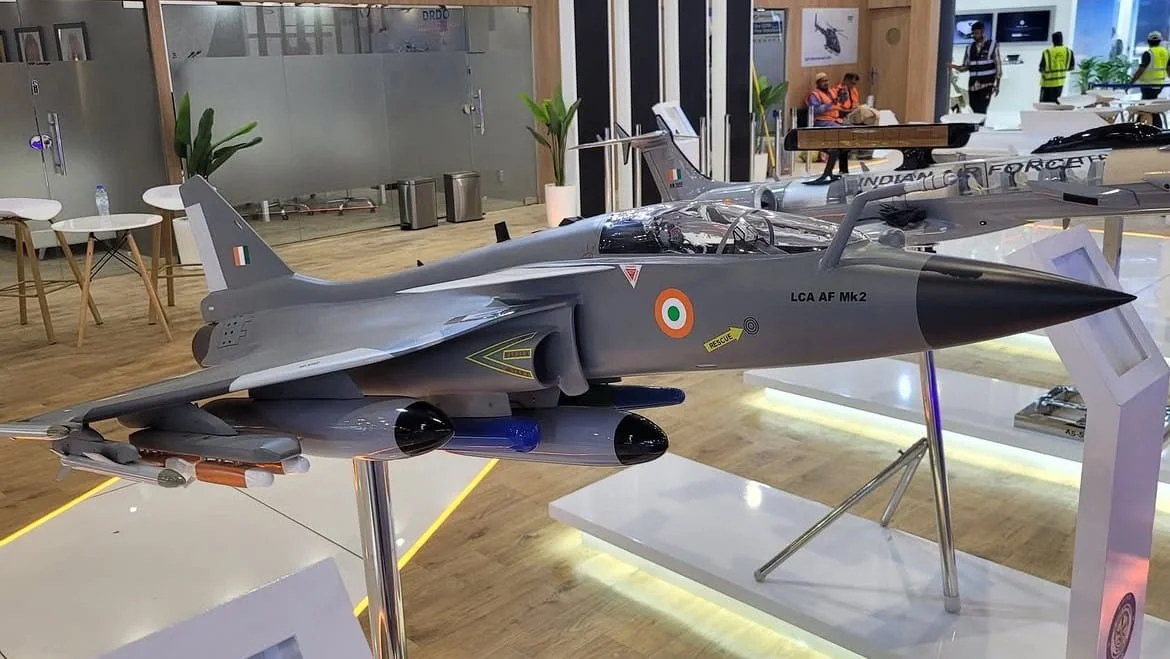
The Tejas Mk2 is being developed as a larger and more capable successor to the Tejas Mk1 and Mk1A. The aircraft is designed as a 4.5-generation medium-weight multirole fighter, with a reported maximum take-off weight of around 17.5 tonnes.
The design incorporates a substantially expanded avionics architecture and greater internal fuel capacity, reportedly exceeding 3,400 kg, while its planned weapons-carrying capability is around 6.5 tonnes.
The fighter is intended to be powered by the General Electric F414-INS6 engine, which is expected to provide approximately 98 kN of thrust. The higher-thrust powerplant is intended to support the larger airframe and its increased payload and fuel capacity compared with earlier Tejas versions.
A critical but less visible stage of fighter development
The latest tender highlights an aspect of fighter development that receives considerably less public attention than engines, radars or weapons.
A modern combat aircraft functions as an interconnected system in which thousands of electrical connections must operate reliably. A problem in a single harness, connector or circuit can potentially affect multiple aircraft functions.

Automated testing can therefore provide engineers with a systematic method of identifying faults before the aircraft enters more demanding stages of ground evaluation.
For PV1, ensuring the integrity of the wiring network will be particularly important before the aircraft undergoes major power-on activities and subsequent systems-level testing.
Prototype moves toward flight-test preparations
The latest development comes as Hindustan Aeronautics Limited (HAL) continues work on the physical manufacture and assembly of Tejas Mk2 prototypes, while ADA undertakes activities related to system integration and procurement of specialised technologies.
Recent programme updates have indicated a target window of March to July 2027 for the first flight of the Tejas Mk2. Meeting that objective will require the successful completion of several intermediate milestones, including structural assembly, systems integration, electrical and avionics validation, ground testing and engine-related activities.
The automated harness-testing contract is therefore significant not because it represents a headline-grabbing new weapon or sensor, but because it reflects the detailed engineering work required to transform an assembled airframe into a fully functional aircraft.
Building confidence before first flight
The transition from structural assembly to systems integration is one of the most demanding phases of any new fighter programme. Every subsystem must work individually while also communicating reliably with the aircraft’s broader architecture.
Successful completion of the cable-harness testing will provide engineers with greater confidence in the electrical foundation of PV1 before increasingly complex testing begins.
The Tejas Mk2 programme is ultimately intended to provide the Indian Air Force with a larger indigenous multirole fighter, with plans reportedly centred on an acquisition of at least 120 aircraft.
As prototype work progresses, individual tenders and subsystem contracts may appear routine, but together they provide an indication of the sequence of technical activities taking the aircraft closer to its first power-on, ground trials and eventual flight testing.